
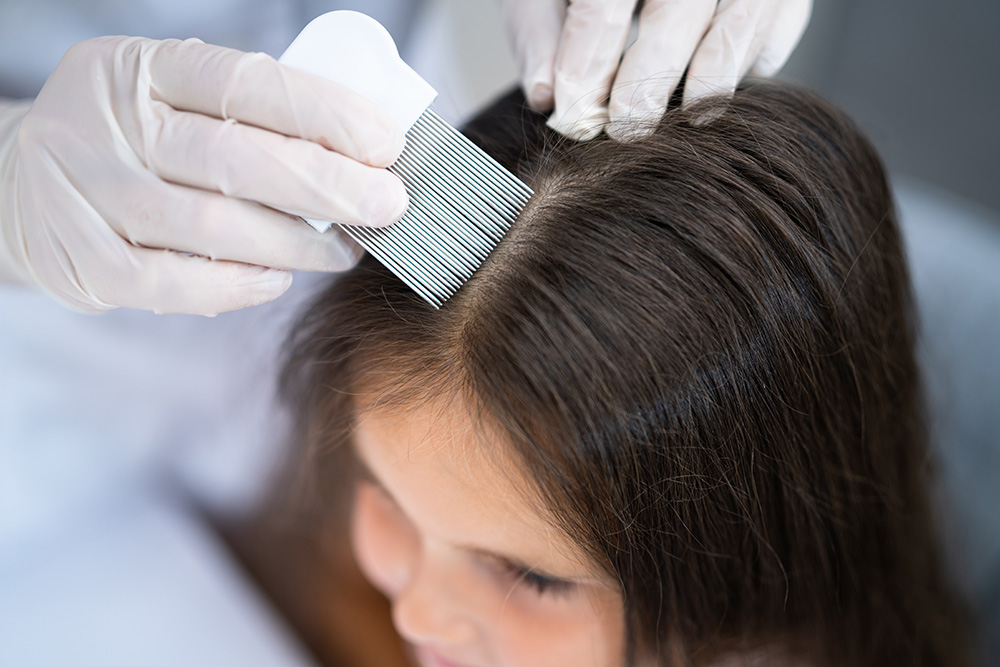
Back-to-school season brings with it new teachers and fresh supplies. It also sometimes brings a dreaded note home about head lice. A letter like that can send a parent straight to the bathroom with a flashlight, ready to search their child’s scalp for the little pests. It’s one of the most common yet most unwelcome parts of the back-to-school season.
Head lice are extremely common. The Centers for Disease Control (CDC) reports that between 6 and 12 million kids in the United States get them every year, so if it’s happening in your home, you’re not alone.
A lice case that gets resolved fast versus one that drags on for weeks can usually depend on the small details, including the right products, the right technique, and the right follow-up timing. With a sense of what lice are, how they spread, and when it makes sense to call a doctor for head lice treatment, you can get your child back to normal faster.
What are head lice?
Head lice are small insects that live on the scalp and feed on human blood. With no wings and no ability to jump, the main way they travel from one person to another is through direct head-to-head contact.
The lice lifecycle has three stages.
- First are the nits, which are eggs that latch tightly onto the hair strands near the scalp.
- After about a week, the nits hatch into nymphs. These are just smaller, younger versions of an adult louse.
- Give them another week or two, and they reach full maturity as adult lice. At this point, they’re roughly the size of a sesame seed.
A single round of head lice treatment for kids is usually not enough to wipe them all out. The reason is pretty simple. Not every nit will have hatched by the time that you do your first application. Any nits that survive will eventually grow into new adult lice. A second application, done about a week later, tends to take care of anything that hatched after the first round.
Why head lice cases spike after back-to-school
The back-to-school season brings crowded classrooms, shared coat hooks, and a whole lot of close head-to-head contact between kids. That proximity is a big part of why the first few weeks of school are usually when cases start to show up.
A common school day is full of close-contact moments from start to finish.
- Kids lean in together during story time.
- Children bump heads over a shared tablet.
- Students squeeze in tight for group photos at recess.
Any one little interaction is all it takes for lice to travel from one head to another. Shared hats, hairbrushes, and headphones can also be a source. However, most cases trace back to direct head-to-head contact.
With so many kids packed into the same space day after day, it’s just something that comes with that environment (much like pink eye).
How to tell if your child has lice
When it comes to head lice symptoms, the first sign most parents see is that their child won’t stop scratching. The child may scratch around the scalp, behind the ears, or the back of the neck.
It’s important to note that a child who isn’t scratching yet could still have lice. That’s because itching can take a few weeks to appear after an infestation takes hold.
If you notice that telltale scratching, a careful check is always worth your time.
- Natural light works best (the brighter the better).
- Use a fine-tooth comb to take a section-by-section pass through the hair to make sure nothing gets missed.
- The best place to start is behind the ears and along the nape of the neck, because lice are most likely to show up in those areas.
As you search, look for two main signs:
- Live lice moving through the hair
- Nits attached to the hair shafts close to the scalp
Nits are very small, and they grip the hair extremely tightly. Unlike loose debris or dandruff, nits won’t move if you try to brush them away.
What lice and nits look like
Nits are the eggs, which are little, teardrop-shaped, and glued tight to the hair shaft. They are usually right near the scalp. Nits are usually white or pale yellow, and no matter how hard you try to flick one off, it just won’t budge.
Live lice are far harder to find. This is mostly because they don’t sit still. At roughly the size of a sesame seed, adult lice are small, fast, and grayish-brown in color, which makes them pretty easy to miss.
Lice vs. dandruff
A quick touch test is all it takes to tell lice and dandruff apart.
- Dandruff flakes will slide or fall right off the hair with almost no effort at all.
- Nits are different. They’re stuck to the hair shaft and won’t budge no matter how hard you flick or brush at them.
If what you see moves without much effort, it’s very likely not a nit.
How to get rid of lice
Head lice are actually very manageable at home. Lice removal takes a bit of patience and a willingness to work through it one step at a time.
Successful head lice treatment depends on three steps, including:
- Using a product strong enough to kill any live lice.
- Nit combing to pull the nits out of the hair.
- Sweeping through your home to cut down the odds of reinfection.
All three of these steps work together, so if you skip even one of them, the whole process can fall apart.
It’s worth noting that lice spread quickly from one person to another through close contact. As a result, another family member may have already picked up lice without anyone realizing it. This means a quick check on everyone at home is worth doing early on.
Finally, know that a single treatment almost never does the full job. Nits are notoriously stubborn, and a follow-up round of combing or treatment is usually a part of the plan, so patience is key.
Over-the-counter treatment options
Permethrin (sold as Nix) and pyrethrin (sold as RID) are the two most common over-the-counter lice treatments. It’s easy to find them at the drugstore.
Either one is worth trying first. Just read the package directions closely and follow them to the letter. Improper use is one of the main reasons these products don’t work the way they should.
Nit combing and follow-up
Even the best lice treatments won’t kill every last nit, which is why wet-combing is a step that you can’t skip. With a fine-tooth nit comb, work through the hair in small sections and rinse the comb off between each pass. This is how most of the removal happens.
You should perform a follow-up treatment around 7 to 10 days later. Any eggs that survived will have hatched by then, and a second treatment works on those newly hatched lice before they can lay more. From there, a hair check every day for two more weeks is worth the effort.
Cleaning the home environment
Bedding, hats, and anything worn recently all need a hot wash (130°F or higher) followed by a high-heat dry cycle. That type of laundering will take care of most of the surfaces in your home.
For anything that can’t go in the wash, just seal it up in a plastic bag for about two weeks. Lice don’t actually live very long once they’re off a human head, so there’s no need to fumigate the whole house or scrub down every corner.
Common head lice myths
Head lice get a way worse reputation than they deserve. A clean home and a child who showers every day are not going to protect against lice because good hygiene doesn’t shield you from head lice.
You should also know that your pets are safe from lice. Head lice can’t live on animals, so the family dog and cat don’t need any treatment at all.
The “no-nit” school policy has been around for a long time, but the American Academy of Pediatrics has recommended revisiting it. Under the old policy, kids were sent home if they had nits in their hair. However, the American Academy of Pediatrics has said nits alone are not a valid reason to pull a child out of class. A missed school day is disruptive, and in most cases, avoidable.
When to see a doctor for lice
Most cases of head lice can be handled at home, and for plenty of families, it stays that way. Help from an urgent care doctor is worth it in some situations, though.
- If lice are still active after two full rounds of over-the-counter treatment, you’re probably dealing with a resistant strain that standard products can’t touch.
- Open sores, puffiness, or fluid due to scratching can signal a secondary infection. This can also merit a doctor’s visit.
- Standard lice treatments are not safe for infants and very young children, so it’s important to reach out to a doctor for proper head lice treatment in that situation.
The longer a lice problem goes on without progress, the worse it tends to get. At some point, if nothing is working, a professional is a much better call than another round of home treatment.
Frequently asked questions
We get a lot of questions from parents about how to get rid of lice, so we’ve put together answers to some of the most common ones right here.
Can head lice survive off the scalp?
Lice don’t last long once they’re away from a human head, which is good news for cleaning up your home. You don’t need to fumigate or scrub every surface. Hot water washing and high-heat drying can take care of most items. Anything else that can’t be washed can go in a sealed plastic bag for two weeks.
Do I need to treat the whole family?
Yes, checking everyone in the household for head lice is an important step because lice spread easily through close contact. Another family member could already have lice without showing any signs yet. Anyone who has lice should go through treatment at the same time to avoid passing them back and forth. Even family members who aren’t itching are worth a close look.
Can my child go to school with lice?
Yes, in most cases, a child with lice doesn’t need to miss school, especially if head lice treatment has already started. The American Academy of Pediatrics has spoken out against policies that send kids home just for having nits, noting that it causes real disruption without much benefit. That said, it’s worth checking your school’s specific policy.
How long does lice treatment take to work?
Treatment is usually a process rather than a one-and-done fix, so it helps to plan for at least a couple of rounds. A follow-up head lice treatment around 7 to 10 days after the first one is an important part of the plan. This catches any lice that hatched after the initial round. Daily hair checks for at least two weeks after that help make sure things are actually resolved.
Get head lice help at State Urgent Care in Starkville
If the over-the-counter options haven’t been working for you, prescription-strength products are a natural next step for head lice treatment. At State Urgent Care in Starkville, we carry stronger treatments that work well for the more resistant cases of lice.
No appointment is needed to get help from our provider, which is at least one less hurdle to jump through to get rid of lice. Contact us to get services and support to get rid of head lice for good.